If you’ve never used an in-room massage service before, it’s natural to have questions. What exactly happens when you book? Who arrives? What does the setup look like? What should you do — and not do — to get the most from the experience?
This guide answers all of those questions clearly and honestly. By the time you finish reading, you’ll know exactly what to expect from the moment you book to the moment your therapist leaves — and you’ll be fully prepared to get the most out of your first in-room massage in Guangzhou. Guangzhou Mobile Massage delivers professional in-room sessions across all major hotel districts, 24 hours a day, 7 days a week.
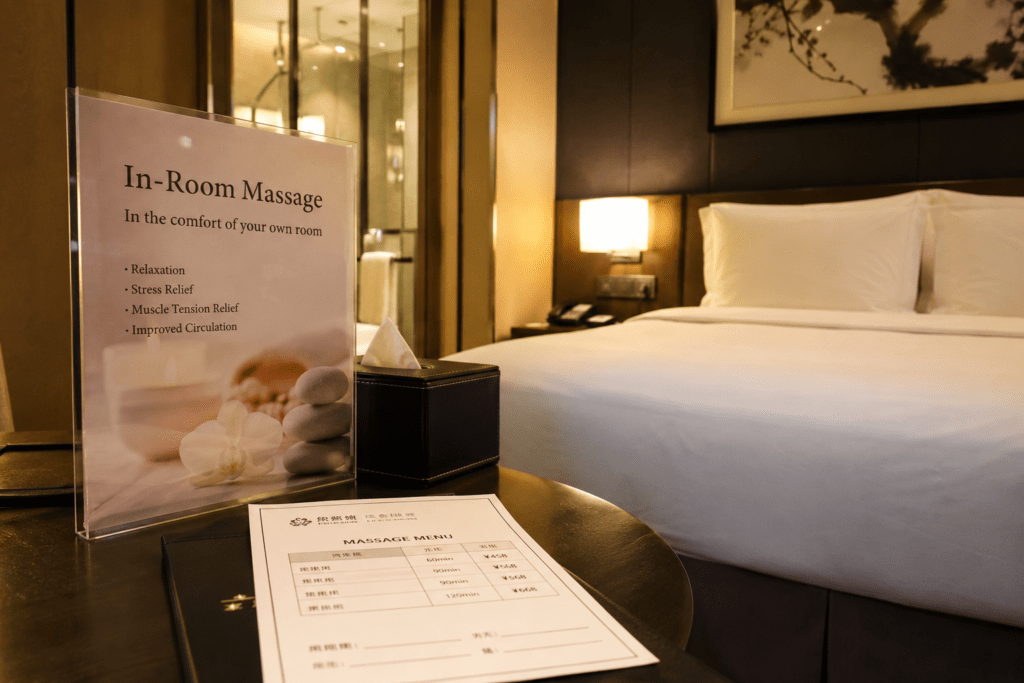
Who This Guide Is For
This guide is written specifically for first-time users of in-room hotel massage services — visitors to Guangzhou who have used spa facilities before but have never had a mobile therapist come to their hotel room, and those who have never had a professional massage at all and want to know what to expect before committing to a booking.
If you’re already familiar with how in-room massage works and are looking for information on treatments, availability, or pricing, the complete Guangzhou massage guide is the better starting point.
Before the Session: What Happens After You Book
Once you confirm your booking — either through the online booking form or via WhatsApp — you receive a confirmation with the details of your session: the treatment type, session length, estimated arrival window, and your therapist’s contact information.
You don’t need to do anything to prepare beyond the simple room setup outlined below. Your therapist handles everything else.
What your therapist brings
Every professional in-room session is fully self-contained. Your therapist arrives with:
- A portable professional massage table — the same standard used in clinic and spa settings, not a folding camping table
- Clean, freshly laundered linens and a face cradle cover for every session
- Professional massage oils appropriate to your chosen treatment
- Any specialist tools required — hot stones for stone massage, essential oil diffuser for aromatherapy treatments, and so on
- Clean towels for draping and post-treatment comfort
You are not expected to provide anything. The only preparation required on your side is a clear floor space large enough to set up the table — approximately 2 metres by 1.2 metres. In most standard hotel rooms, moving the luggage rack or a chair to one side is sufficient.
Arrival: The First Five Minutes
Your therapist will message you via WhatsApp approximately 5–10 minutes before arriving to let you know they’re on their way. They will typically meet you at the hotel lobby or come directly to your floor depending on the hotel’s access policy — either is straightforward and takes no more than a few minutes.
When they arrive at your room, they will introduce themselves, confirm the treatment and session length, and begin setting up the portable table while you make any final adjustments to the room — temperature, lighting, music preference if any.
A note on hotel access
Professional mobile massage therapists in Guangzhou are accustomed to accessing all categories of hotel — from budget business hotels to five-star international properties. If your hotel has a strict guest policy, simply meet your therapist at the lobby and accompany them up. This is entirely routine and takes two minutes.
Setup: What It Looks Like in Your Room
Setup takes approximately 5–8 minutes. The portable massage table is assembled quietly and efficiently — these are well-designed professional pieces of equipment that fold out and lock into position without fuss. Clean linens are laid, the face cradle is attached and positioned, and oils or specialist tools are arranged within reach.
The result is a clean, professional treatment setup that looks and functions identically to what you’d find in a quality spa treatment room — within the familiar, private environment of your own hotel space.
Room temperature is worth setting before the therapist arrives. For most massage treatments involving exposed skin and massage oil, 22–24°C is comfortable. If the room is too cold, oil-based treatments become uncomfortable quickly once the body is still on the table. Most hotel rooms reach a stable temperature within 10–15 minutes of adjustment, so set the air conditioning when you receive the pre-arrival message.
The Consultation: What Your Therapist Will Ask You
Before beginning the treatment, your therapist will spend 3–5 minutes in consultation. This is a standard part of every professional session and is not a formality — the information you provide directly shapes what happens during the next 60 or 90 minutes.
Expect to be asked about:
- Your primary areas of concern — where do you feel the most tension, pain, or discomfort? Be as specific as you can: “right side of my neck and the base of my skull,” “lower back, particularly on the left,” “both calves and the soles of my feet.” Specific information gets you a better session than general answers.
- Pressure preference — light, medium, firm, or very firm. If you’ve never had a professional massage, start with medium and adjust from there during the session.
- Health conditions and contraindications — recent surgery, injuries, skin conditions in the treatment area, blood pressure medication, pregnancy, or any other relevant medical information. This is not a bureaucratic question — it allows your therapist to modify techniques that might otherwise be inappropriate for your specific situation.
- Areas to avoid — if there are areas you’d prefer not to have worked on, simply say so. A professional therapist will note this and respect it without question throughout the session.
- Context for your visit — knowing you’ve just come off a 14-hour flight, or that you have an important presentation in the morning, or that you’ve been standing on a concrete exhibition floor for two days, allows a skilled therapist to prioritise intelligently rather than following a generic routine.
During the Treatment: What to Expect on the Table
Once the consultation is complete, you’ll be given a moment of privacy to undress to your comfort level and position yourself on the table under the provided draping. Professional draping — the use of clean linens to cover the parts of your body not currently being treated — is maintained throughout every session as standard.
What “normal” feels like
If this is your first professional massage, a few sensations are worth knowing about in advance so they don’t come as a surprise:
- Muscle release sensation — when a therapist works on a tight or knotted area, the release of tension can feel like a deep ache or mild burning that fades quickly. This is normal and usually followed immediately by a sense of relief and warmth in the area.
- “Good hurt” during trigger point work — sustained pressure on a trigger point (a hyperirritable knot in a muscle) can produce a distinctive discomfort that most people describe as “hurts but in a good way.” This is the pressure releasing the knot. Communicate freely if it crosses from productive discomfort into genuine pain — your therapist will adjust immediately.
- Referred sensation — pressure in one area sometimes produces sensation in a seemingly unrelated area. Neck trigger points can refer sensation into the temple or behind the eye. Hip trigger points can refer down the leg. This is a normal and informative part of the treatment, not a cause for concern.
- Feeling drowsy — this is one of the most common responses to massage, especially for visitors dealing with jet lag or travel fatigue. If you drift off during the session, that’s perfectly fine. Your therapist will continue the treatment and wake you gently at the end.
Communicate throughout
You are not expected to stay silent throughout the session. If the pressure is too much or not enough, say so. If you’d like more time on a particular area, ask. A professional therapist welcomes this feedback — it’s how they deliver a genuinely effective session rather than a routine one.
Draping and Privacy: What to Know
Professional draping standards mean that only the area of your body currently being treated is uncovered at any time. When your therapist works on your back, your lower body is draped. When they move to your legs, your back is re-covered. This is standard clinical practice and applies throughout every session without exception.
You set your own comfort level for how much or how little clothing you wear under the draping. Most people undress fully (underwear optional) for oil-based treatments, as this gives the therapist the cleanest access and avoids oil staining clothing. For Thai massage and some traditional Chinese treatments performed clothed, your therapist will advise the appropriate attire at the start of the session.
After the Treatment: The Final Phase
At the end of your session, your therapist will give you a moment of privacy to re-dress and will then offer brief post-treatment guidance. This typically covers:
- Hydration — drink water promptly and consistently for the next few hours
- Activity — rest rather than intense exercise; light walking is fine
- Expected aftereffects — mild muscle soreness in worked areas is normal for 24–48 hours, particularly after deep tissue work; this is equivalent to the feeling after a productive gym session
- Follow-up recommendations — if your therapist identifies areas that would benefit from additional attention, they will mention this and suggest an appropriate follow-up treatment or frequency
Pack-down takes approximately 5 minutes. Your room is returned to its original arrangement. The entire visit — from the therapist’s arrival to their departure — is typically 15–20 minutes longer than the treatment itself.
Common First-Timer Questions
Do I have to talk during the massage?
No. Some people prefer complete silence; others like brief conversation. Either is fine. The one exception is communication about pressure and comfort — that’s always welcome and useful. Beyond that, follow whatever feels natural to you.
What if I need to adjust during the session?
Simply say so. Asking for more or less pressure, requesting more time on a specific area, or asking your therapist to avoid a particular spot mid-session is entirely normal and a routine part of a professional treatment. Nothing about these requests is awkward or unusual.
Is it normal to feel emotional during or after a massage?
Yes. Massage releases physical tension that is sometimes connected to emotional holding patterns — this is a well-documented phenomenon. Some people experience unexpected emotion during deep tissue work on the upper back and chest. This is normal, passes quickly, and is simply part of the body’s processing response. There is nothing to be concerned about.
How will I feel immediately afterwards?
Most people feel deeply relaxed, warm, and slightly heavy-limbed immediately after a session — a state sometimes called “massage drunk.” This typically transitions to a feeling of lightness and wellbeing within 20–30 minutes. For visitors dealing with travel fatigue, the most common response is simply wanting to sleep — which is the best thing you can do. See our guide on how to recover from travel fatigue in Guangzhou for a full post-massage recovery protocol.
Will I be sore the next day?
After deep tissue work, mild soreness in treated areas is normal for 24–48 hours — similar in character to delayed onset muscle soreness after exercise. It is not a sign that anything went wrong; it reflects genuine work done on the tissue. Hydration, light movement, and a warm shower the following morning will help it resolve quickly.
How soon should I book again?
For visitors on a multi-day business trip or trade fair visit, a session every 2–3 days provides the best cumulative recovery benefit. For a one-off visit, even a single well-timed session makes a measurable difference to how you feel across the remainder of your stay. Our guide on the best massage after a long flight in Guangzhou covers optimal timing for your first session after arrival.
In-Room vs Spa: Is the Experience Different?
The treatment quality of an in-room massage from a qualified professional is identical to what you receive in a spa environment. The therapist, techniques, equipment, and standards are the same. What changes is the context — and for most Guangzhou visitors, the context of your own hotel room is an advantage rather than a compromise.
There’s no transit stress, no shared changing facilities, no background noise from other guests, no unfamiliar environment to adjust to. The absence of these friction points means you arrive on the table already more relaxed than you would be after commuting to a spa — which directly improves the quality of the treatment itself. For a full breakdown of how the two options compare across every relevant dimension, read our article on hotel massage vs spa in Guangzhou.
Ready to Book Your First In-Room Massage in Guangzhou?
You now know exactly what to expect — from the moment you confirm your booking to the moment your therapist packs up and leaves. There are no surprises, no awkward unknowns, and nothing complicated about the process. It is a straightforward, professional service designed to fit around your schedule and deliver genuine physical recovery in the most convenient setting possible.
Related Services
Hotel Massage
24/7 outcall
Foot Massage
Reflexology
Thai Massage
Stretching
Deep Tissue
Chronic tension
Swedish
Relaxation
Sports Recovery
Post-workout
Hot Stone
Heat therapy
Sleep Improvement
Evening ritual
Neck & Shoulder
Tension relief
You May Also Like
Frequently Asked Questions
Looking for Professional Hotel Massage in Guangzhou?
Recover faster with our licensed therapists – available 24/7 at your hotel.