Hotel Massage vs Spa in Guangzhou: Which Option Is Better for Travelers?
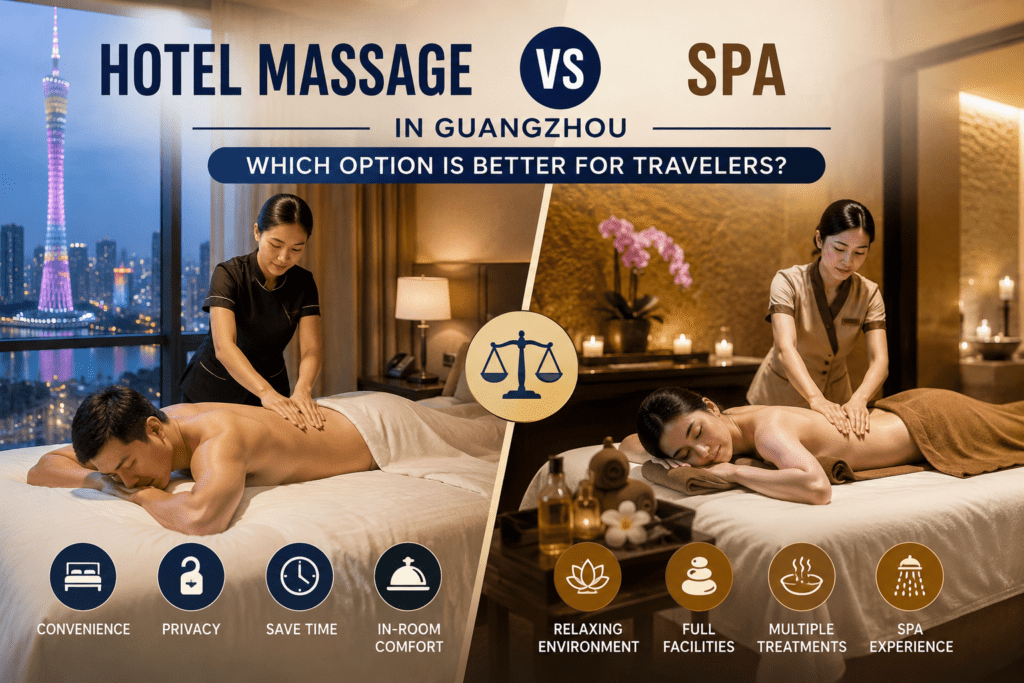
Guangzhou offers travelers two main paths to post-travel recovery: hotel massage services delivered to your room, and standalone spa centers spread across the city. For time-pressed business visitors and Canton Fair attendees, in-room massage removes the hassle of commuting after an exhausting day. Traditional spas, on the other hand, offer a fuller sensory environment suited to leisurely half-day retreats. This guide breaks down both options across convenience, cost, privacy, and comfort so you can decide which fits your itinerary — and your body — best.
Introduction
Guangzhou is one of China’s most commercially dynamic cities, drawing tens of thousands of international visitors every year for trade fairs, manufacturing negotiations, and corporate meetings. The Canton Fair alone brings roughly 200,000 overseas buyers to the city twice annually, and the broader Pearl River Delta business corridor keeps hotel occupancy high for most of the year. When you’re putting in 10-hour days on a convention floor or sitting through back-to-back supplier meetings, the appeal of a proper massage at the end of the night isn’t a luxury — it’s practically maintenance.
The question most travelers face isn’t whether to get a massage, but how. Guangzhou has both a mature hotel wellness industry and a sprawling network of traditional spa centers, each with its own advantages. Understanding the difference between hotel massage and a standalone spa in Guangzhou matters more than it might seem, because the wrong choice can cost you an hour of travel time you didn’t have or leave you underwhelmed when you were expecting a complete spa environment.
This article walks through both options in honest detail. Whether you’ve just stepped off a 14-hour flight, wrapped up a full day at Poly World Trade Centre, or simply need your lower back to cooperate for tomorrow’s presentations, here’s what you need to know before you book.
Understanding Hotel Massage Services in Guangzhou
Hotel massage in Guangzhou refers to professional massage therapy arranged through your accommodation — either delivered directly to your guest room or provided in a dedicated wellness suite within the hotel itself. The defining feature is that you never leave the building. A trained therapist arrives at your door with a portable table, professional-grade oils, and a structured treatment menu, typically ranging from 60 to 120 minutes. Higher-end properties often have a permanent in-house spa floor with treatment rooms that function like a condensed wellness center.
In-room massage, specifically, has grown significantly in popularity among international travelers over the past decade. The service works simply: you contact the hotel concierge or book through the property’s own app, select a treatment style (Swedish relaxation, deep tissue, traditional Chinese Tui Na, or reflexology are the most common options in Guangzhou), choose a time slot, and a therapist appears at your door. Most hotels operating in the international business segment employ bilingual wellness staff, which removes the language barrier that can make standalone spa visits awkward for non-Mandarin speakers.
The service is ideally suited to travelers arriving late from the airport, guests with early-morning commitments who can’t afford the wind-down time of a spa excursion, and anyone who values privacy above atmosphere. You remain in your own space throughout. You don’t sit in a shared waiting room, you don’t navigate unfamiliar streets after dark, and you can go straight to sleep the moment the session ends. For many road warriors, that last point alone makes it the obvious choice.
It’s also worth noting that reputable hotel massage services in Guangzhou operate under formal licensing requirements. Hotels affiliated with international chains are especially diligent about compliance, and their in-house therapists are typically certified professionals rather than ad hoc arrangements. If you’re new to the city and uncertain about quality, starting with your hotel’s own wellness service is almost always the lower-risk path. For more on recovery options right after landing, see our guide on Best Massage After a Long Flight in Guangzhou.
Understanding Traditional Spa Services
A traditional spa in Guangzhou is a standalone wellness facility — often multi-floor, sometimes housed in a dedicated building — that provides a wider range of treatments than any hotel room can accommodate. The experience is architectural as much as therapeutic. You check in at a reception desk, change into a provided robe and slippers, and move through a sequence of spaces: steam rooms, dry saunas, hydrotherapy pools, relaxation lounges, and private treatment rooms. The environment is designed to create separation from the outside world.
Service menus at Guangzhou’s better spa centers tend to be extensive. Beyond standard massage modalities, many offer traditional Chinese medicine-based treatments such as cupping, gua sha, and herbal compress therapy. Skin care and body treatments — exfoliation, wraps, facials — are also standard offerings. Some larger facilities, particularly those attached to luxury hotels in Tianhe and Zhujiang New Town, incorporate traditional Cantonese wellness philosophy into their programming, blending ancient practice with modern technique in ways that are genuinely distinct from what you’d find in a Western spa.
The cost structure at spas also differs meaningfully from hotel massage. Most traditional spa centers in Guangzhou price their services individually, but many also offer half-day or full-day packages that bundle treatments, meals, and unlimited use of wet facilities into a flat rate. For a traveler who has carved out a full afternoon for recovery, these packages can represent good value. The trade-off is time: a proper spa visit, including travel, intake, treatment, and unwinding afterward, typically runs three to five hours minimum.
The spa environment also assumes a certain mood. The experience works best when you arrive without time pressure, have no meetings until the following morning, and genuinely want an immersive break from the city. It’s a retreat format, not a quick-fix format. That distinction matters a great deal when you’re planning around a packed business schedule.
Hotel Massage vs Spa: Key Differences
Both options deliver real therapeutic benefit. The differences come down to context, logistics, and what you’re actually optimizing for when you book.
| Factor | Hotel / In-Room Massage | Traditional Spa |
|---|---|---|
| Convenience | Maximum — no travel required | Requires commute, often 15–40 min each way |
| Privacy | Complete — your own room | Shared common areas, shared changing rooms |
| Travel Time | Zero | 30–80 minutes total transit |
| Comfort Level | Familiar environment, own bedding | Purpose-built wellness environment |
| Booking Process | Simple — concierge or hotel app | Direct booking, may require advance reservation |
| Flexibility | High — evening and late-night slots common | Standard business hours, weekend crowds |
| Cost | ¥300–¥800 per session typical | ¥200–¥600 per treatment; packages ¥600–¥1,500+ |
| After-Treatment Rest | Immediate — bed is right there | Requires travel home while effects are peaking |
Convenience
This is where hotel massage has an undeniable edge. When your last meeting ends at 9 p.m. and you have a breakfast briefing at 8 a.m., the prospect of ordering a DiDi, navigating Guangzhou traffic, finding a spa you haven’t vetted, communicating your preferences in Mandarin, and making it back before midnight is genuinely unappealing. Hotel massage collapses that entire logistical chain. You text the concierge, confirm a time, and someone knocks on your door.
Privacy
In-room massage is inherently private in a way a spa cannot replicate. There are no shared changing areas, no strangers in the relaxation lounge, no ambient noise from adjacent treatment rooms. For executives who spend all day in high-visibility environments, the psychological benefit of true solitude during a massage is real and not trivial.
Travel Time
Guangzhou’s traffic — particularly around Yuexiu, Haizhu, and Baiyun districts during evening hours — can turn a 5-kilometer spa trip into a 45-minute ordeal. That’s nearly an hour of productive sleep or wind-down time gone before the treatment even begins. Hotel massage eliminates this entirely.
Comfort Level
Spas are designed to be comfortable, and good ones are genuinely beautiful spaces. But your hotel room is calibrated to you — your preferred temperature, your pillow arrangement, your ambient noise preference. Post-massage, that familiarity helps the body settle faster. Many guests fall asleep within minutes of a session ending, which simply isn’t possible if you still need to get dressed and take a car home.
Booking Process
Hotel massage is typically easier to arrange. Most four- and five-star properties in Guangzhou have streamlined concierge systems, and many now offer mobile booking through their apps. Spa centers vary widely in how accessible their booking process is for English-speaking guests; some have excellent online systems, others require a phone call in Mandarin.
Flexibility
Many hotel wellness services in Guangzhou offer availability until 11 p.m. or midnight. Traditional spas typically close earlier, often by 10 p.m., and the final appointment slots fill up fast on weekends and during Canton Fair season. If your schedule runs late — which it often does during trade fair weeks — hotel massage is simply more accommodating.
Cost Considerations
The price difference between hotel massage and spa services in Guangzhou is smaller than many travelers expect. Hotel in-room massage can run slightly higher than a comparable treatment at a mid-range spa, but when you factor in transportation costs and time, the effective cost difference narrows considerably. Premium spa packages with wet facilities are genuinely better value for extended sessions, but for a standard 60–90 minute treatment, the pricing is broadly comparable.
After-Treatment Relaxation
This may be the most underrated factor. The 20–30 minutes immediately following a good massage are physiologically significant — muscle tissue is warm and pliable, cortisol is suppressed, and the nervous system is in a restorative state. Sitting in a car or subway during that window actively undermines the benefit. Falling asleep in your own bed maximizes it. For anyone serious about recovery, this alone makes in-room massage worth the modest premium.
Why Business Travelers Often Prefer Hotel Massage
Talk to enough frequent business travelers passing through Guangzhou, and a clear pattern emerges: most of them have tried both options and migrated toward hotel massage. The reasons aren’t arbitrary. The structure of a business trip to Guangzhou — dense daytime schedules, unpredictable meeting lengths, the social obligations of evening dinners with suppliers or clients — leaves very little flexible time. What remains tends to be late, quiet, and personal.
Consider a fairly typical Canton Fair week. You’re at the exhibition center in Pazhou from 9 a.m. to 6 p.m. walking 15,000 steps across 1.2 million square meters of floor space. Your legs ache, your lower back is locked from hours of standing at booths, and your shoulders have taken the toll of carrying sample bags all afternoon. You have a supplier dinner until 9:30 p.m., after which you need to prepare notes for tomorrow’s factory visit. There’s simply no version of that evening that accommodates a spa trip. A hotel massage booked for 10:15 p.m.? That fits.
There’s also the question of jet lag and irregular sleep. Many international travelers to Guangzhou are operating on disrupted circadian rhythms, particularly those arriving from the Americas or Europe. A late-evening massage in the quiet of your own room can meaningfully improve sleep onset, which pays dividends across an entire trip. Research in sports medicine has consistently linked post-exertion soft tissue work to improved recovery, and the same principles apply to trade fair fatigue. For more on this, see our overview of Why Business Travelers Choose Hotel Massage in Guangzhou.
Finally, there’s the question of professional discretion. Executives and senior buyers often prefer not to be seen in a spa waiting room by colleagues or business contacts. Hotel massage offers complete separation from the professional sphere — something that matters more in certain industries and cultures than others.
When a Spa Might Be the Better Choice
This isn’t a one-sided comparison. There are real situations where a traditional spa in Guangzhou is the superior option, and it’s worth being honest about them.
If you’ve built a free afternoon into your itinerary — a genuine four-to-five-hour window with no professional obligations — a reputable Guangzhou spa offers an experience that no hotel room can replicate. The combination of sauna, steam, hydrotherapy, and a 90-minute treatment sequence in a purpose-built environment is deeply restorative in a qualitatively different way. The cumulative physiological effect of wet heat followed by massage followed by cool-down in a relaxation lounge outperforms a standalone in-room session, all else being equal.
Spa visits also make sense for travelers who genuinely enjoy the social ritual of the spa environment — the robe, the tea service, the ambient music, the transition between spaces. For some people, that context is part of what makes the experience therapeutic. An in-room massage is efficient and effective, but it doesn’t replicate the feeling of having fully left your work life behind for a few hours.
Couples or small groups traveling together may also find spa visits more satisfying. Many facilities in Guangzhou offer couples’ treatment rooms and social bathing areas that turn a wellness session into a shared experience — something the logistical constraints of in-room massage don’t easily accommodate.
Benefits of In-Room Massage for Canton Fair Visitors
The Canton Fair deserves its own section in any guide to Guangzhou wellness, because its physical demands are exceptional even by trade show standards. The China Import and Export Fair Complex is the largest exhibition center in the world by floor space, and attendees regularly cover 10 to 15 kilometers per day on foot. Over five days of active participation, the cumulative physical load — on the feet, knees, lower back, and shoulders — is substantial. Many exhibitors arrive with pre-existing tension and leave with acute muscle fatigue layered on top of it.
In-room massage addresses several of these issues directly. A targeted deep-tissue session on the lumbar spine, glutes, and calves can meaningfully reduce next-day soreness and improve range of motion. Regular evening sessions throughout a fair week can prevent the kind of gradual stiffening that has some visitors limping through day four. Reflexology, a traditional foot massage technique widely practiced in Guangzhou, offers targeted relief that many fair-goers find especially effective after prolonged standing on concrete exhibition floors. For a complete guide to the area’s best recovery options, see Top Massage Options Near Canton Fair Guangzhou.
Sleep quality is another significant concern during fair weeks. The combination of mental overstimulation, time zone disruption, and physical fatigue creates a paradoxical state where the body is exhausted but unable to settle easily. A structured 60–90 minute massage before bed activates the parasympathetic nervous system, reduces circulating adrenaline, and generally makes sleep onset faster and sleep quality deeper. Over a five-day fair, this compounds: better sleep each night means sharper decision-making and more sustained energy the following day.
Jet lag, a perennial challenge for intercontinental visitors, also responds well to strategic massage therapy. By accelerating the body’s transition to local sleep timing and reducing the anxiety-like symptoms of circadian disruption, evening massage can shave a day or two off the typical adjustment period. For travelers crossing six or more time zones to attend the Canton Fair, that’s a meaningful competitive advantage. Learn more about managing travel fatigue in our guide on How to Recover from Travel Fatigue in Guangzhou.
How to Choose the Right Massage Service in Guangzhou
Whether you’re booking in-room massage through your hotel or selecting a standalone spa, a few practical criteria separate quality providers from the rest. Taking five minutes to evaluate these factors before you book will almost always result in a better experience.
Reviews from other international travelers are the most reliable signal. Platforms like TripAdvisor, Google Maps, and Booking.com all carry verified guest feedback, and reviews specifically from English-speaking visitors will tell you whether the communication process was smooth and whether the quality of technique matched the price point. Look for consistent mentions of professionalism rather than superlatives; genuine reviews tend to be specific.
Therapist credentials matter more than venue aesthetics. In Guangzhou, look for services that specify their therapists hold recognized Chinese massage certifications (中医推拿师 or equivalent). Reputable hotels and spa centers will disclose this information readily; evasion on this point is a yellow flag.
Transparent pricing is a basic quality signal that many travelers overlook. A legitimate massage service in Guangzhou will quote a clear, all-inclusive price before any service begins, with no ambiguity about gratuity or add-ons. If pricing feels deliberately opaque during the booking process, trust that instinct and look elsewhere.
English-language communication capability is especially important for visitors who have specific medical considerations — a lower back injury, recent surgery, pregnancy — that the therapist needs to understand before beginning. A service that can’t communicate these nuances fluently in English introduces unnecessary risk. Most premium hotel wellness services and many established spa centers in Guangzhou now employ bilingual staff; this should be a baseline expectation, not a bonus.
Finally, look for an online booking system. The ability to confirm an appointment, review the treatment menu, and pay in advance (or have an unambiguous hotel room charge arrangement) signals organizational maturity. It also gives you a record of what was agreed, which occasionally matters.
Frequently Asked Questions
Is hotel massage legal in Guangzhou?
Yes, hotel massage services in Guangzhou are fully legal when provided by licensed establishments and certified therapists. Hotels operating under international brand affiliations are subject to regular compliance reviews and are reliably legitimate. The city’s massage industry is regulated under Chinese health and tourism service law, and reputable in-room massage providers operate within that framework. As with any city, it pays to book through established hotels or verified services rather than responding to unsolicited street offers.
Is a spa better than an in-room massage?
Neither is objectively better — they serve different needs. A spa provides a richer environmental experience, a wider treatment menu, and wet facilities that deliver benefits beyond what a portable table session can achieve. An in-room massage is faster to arrange, more private, and significantly more convenient for travelers with tight schedules. For most business visitors and Canton Fair attendees, in-room massage is the more practical choice. For leisure travelers with a free afternoon, a reputable Guangzhou spa is worth the extra logistics.
How much does hotel massage cost in Guangzhou?
In-room massage at a four- or five-star hotel in Guangzhou typically runs between ¥300 and ¥800 (roughly USD 40–115) for a 60–90 minute session, depending on the treatment type and the property’s overall pricing tier. Some boutique wellness services operating independently of hotels offer competitive rates in the ¥250–¥500 range for the same duration. Traditional spa packages in Guangzhou vary widely, from around ¥200 for a basic foot massage session to ¥1,500 or more for premium half-day packages that include multiple treatments and facility access.
Can I book a massage directly to my hotel room?
In most cases, yes. The majority of four- and five-star hotels in Guangzhou either offer their own in-room massage service or can arrange one through a trusted partner provider. Contact the concierge desk directly, or check whether your property’s mobile app includes a wellness booking function. Some hotels require a minimum booking window of two to four hours in advance; others accommodate same-day requests with as little as 30 to 60 minutes’ notice. It’s worth confirming availability when you check in rather than waiting until the end of a long day.
What is the best option for business travelers?
For the majority of business travelers visiting Guangzhou — particularly those attending the Canton Fair, conducting factory audits, or participating in multi-day conference schedules — hotel massage and in-room massage services offer the best practical fit. The combination of zero travel time, late availability, complete privacy, and immediate access to sleep afterward aligns well with the realities of a business itinerary. Spas remain a strong option for designated rest days or longer leisure stays, but when the primary constraint is time, in-room massage consistently wins.
Conclusion
Both hotel massage and traditional spa services have genuine merit for travelers in Guangzhou, and the right choice depends entirely on what your schedule and your body actually need on a given day. Spas offer depth, environment, and a completeness of experience that is hard to replicate anywhere else. For a traveler with a free afternoon and no professional commitments until the following morning, a well-chosen spa in Guangzhou can be genuinely restorative in a way that resets the entire trip.
For the much larger group of visitors operating on compressed itineraries — the Canton Fair buyer on day three of five, the procurement manager with a 7 a.m. factory tour, the executive whose last call ended at 9:30 p.m. — in-room hotel massage is simply the more functional option. It requires no planning buffer, no transit risk, no language navigation, and no delay between treatment and sleep. The therapeutic outcome is real, the convenience is unmatched, and the recovery benefit compounds meaningfully across a full trip.
If you’re arriving in Guangzhou for business and haven’t yet decided how to manage your physical recovery, start with hotel massage. It’s lower friction, lower risk, and genuinely effective. You can always add a spa day if the schedule opens up. The city has excellent options in both categories — the goal is simply to make sure you’re getting proper rest so you can actually perform at the level that made the trip worthwhile in the first place.
Related Services
Hotel Massage
24/7 outcall
Foot Massage
Reflexology
Thai Massage
Stretching
Deep Tissue
Chronic tension
Swedish
Relaxation
Sports Recovery
Post-workout
Hot Stone
Heat therapy
Sleep Improvement
Evening ritual
Neck & Shoulder
Tension relief
You May Also Like
Frequently Asked Questions
Looking for Professional Hotel Massage in Guangzhou?
Recover faster with our licensed therapists – available 24/7 at your hotel.