✨ Key Takeaways
- Travel fatigue in Guangzhou combines jet lag, muscle soreness, and mental exhaustion — each requiring a different recovery approach.
- Hydration, light movement, and strategic sleep timing are the fastest free methods to reset your body clock after arrival.
- Professional in-room massage accelerates physical recovery significantly faster than rest alone, particularly after long-haul flights.
- Most business travelers recover fully within 24–48 hours when combining multiple recovery methods rather than relying on sleep alone.
Guangzhou is one of Asia’s most demanding business destinations. Whether you’ve flown in from London, Lagos, or Los Angeles, the combination of long-haul travel, time zone shifts, and the pressure of business commitments creates a specific kind of exhaustion that doesn’t resolve on its own. This guide covers what travel fatigue actually is, why Guangzhou trips make it worse, and the most effective ways to recover — quickly and practically.
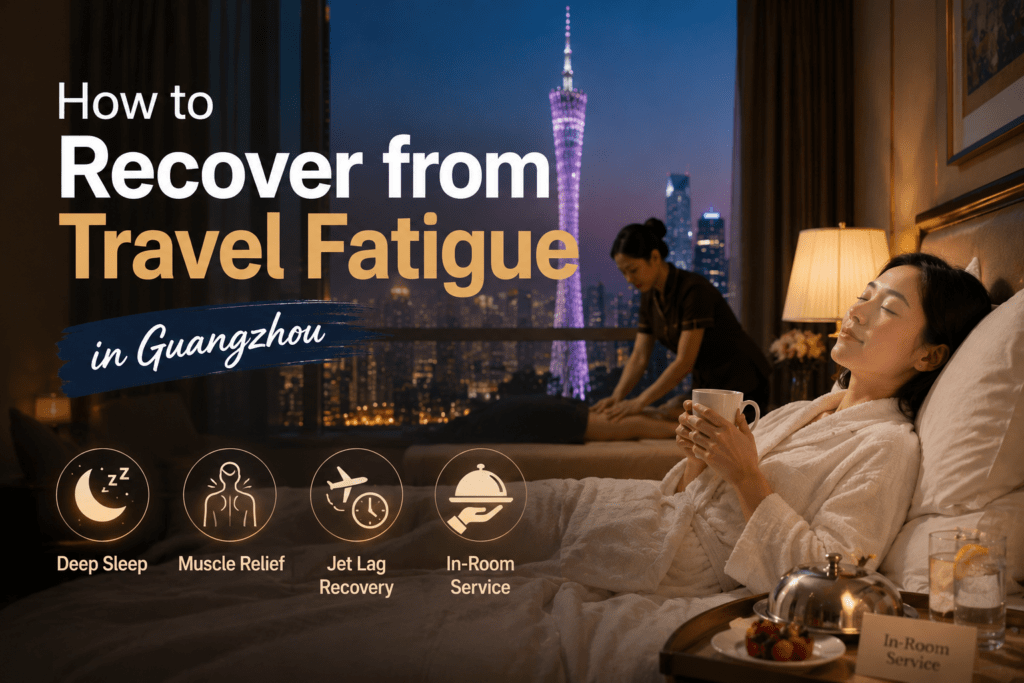
What Is Travel Fatigue and Why Is It Different from Ordinary Tiredness
Most people use “travel fatigue” and “jet lag” interchangeably. They’re related, but they’re not the same thing.
Jet lag is a circadian rhythm disruption — your internal body clock is out of sync with the local time zone. It causes sleep problems, difficulty concentrating, digestive issues, and mood shifts. It’s a biological response to crossing multiple time zones quickly.
Travel fatigue is broader. It includes jet lag, but also the physical strain of sitting in a pressurized cabin for 10 or 14 hours, the dehydration that long flights cause, the muscle stiffness from limited movement, the mental exhaustion of airports and transfers, and the accumulated stress of arrival logistics.
For business travelers arriving in Guangzhou, there’s an additional layer: you’re not arriving to rest. You’re arriving to perform. Meetings, site visits, trade show attendance, and relationship management begin almost immediately. The body is already running a deficit before the work even starts.
Understanding this distinction matters because the recovery approach is different. Jet lag responds well to light exposure and sleep timing. Physical muscle fatigue responds to movement and bodywork. Mental exhaustion responds to genuine rest and stress reduction. Addressing only one of these while ignoring the others explains why so many travelers still feel depleted halfway through their trip.
Why Guangzhou Specifically Makes Travel Fatigue Worse
Not all destinations create the same level of fatigue. Guangzhou has several characteristics that compound the problem.
Time zone distance. For visitors from Western Europe, the time difference is 7–8 hours. From the US East Coast, it’s 12–13 hours. These are among the largest possible shifts, and the body takes approximately one day per hour of time zone change to fully adjust — meaning complete adaptation can take up to two weeks.
Flight duration. Direct flights to Guangzhou from Europe take 11–13 hours. From North America, connections typically add 3–5 hours to that. Total travel time of 16–20 hours is common for intercontinental visitors.
Arrival conditions. Guangzhou’s climate — particularly during spring and autumn Canton Fair seasons — involves high humidity and temperatures that feel physically demanding to visitors from cooler climates. The city is large and fast-paced. Navigating it while already fatigued adds to the cognitive load.
Immediate business pressure. Unlike leisure travel where you can spend the first day adjusting at your own pace, business travel to Guangzhou typically means commitments starting within 24 hours of arrival. There’s rarely a genuine recovery window built into the schedule.
The Physical Symptoms of Travel Fatigue to Watch For
Recognizing the specific symptoms helps you target the right recovery method for each one.
Muscle stiffness and soreness — particularly in the lower back, hips, neck, and legs — comes from sustained immobility in economy or business class seating. Blood pools in the legs. The hip flexors shorten. The thoracic spine compresses. This doesn’t resolve with sleep; it requires movement or physical treatment.
Swollen feet and ankles develop from reduced circulation during long flights. Walking feels heavier than usual. Tight footwear becomes uncomfortable.
Headaches are often caused by cabin dehydration — the humidity level in aircraft cabins is typically 10–20%, far lower than the 40–60% most people are accustomed to.
Mental fog — difficulty concentrating, slower decision-making, reduced verbal fluency — comes from both sleep disruption and the cognitive demands of travel. It can persist for several days if the underlying sleep debt isn’t addressed.
Digestive discomfort is common after long-haul travel due to disrupted meal timing, different food, cabin pressure changes, and reduced physical activity.
Mood disruption — irritability, low motivation, reduced patience — is a consistent feature of significant jet lag. It affects interpersonal performance in business settings more than most travelers acknowledge.
How Long Does Travel Fatigue Last in Guangzhou
The honest answer depends on where you flew from and how you manage recovery.
For visitors from Southeast Asia or Australia with a 2–4 hour time difference, meaningful fatigue typically resolves within 24–36 hours with normal sleep.
For visitors from the Middle East or South Asia with a 4–6 hour shift, recovery takes 2–4 days without active intervention.
For visitors from Europe or the Americas facing 7–13 hour time zone changes, full circadian adjustment can take 7–10 days. However, functional recovery — feeling well enough to perform at a reasonable level — typically happens within 2–3 days when recovery strategies are applied consistently.
The key variable is whether you treat recovery as active or passive. Passive recovery — just sleeping and hoping — is slow. Active recovery — combining light management, movement, nutrition, hydration, and physical treatment — is significantly faster.
Effective Methods to Recover from Travel Fatigue in Guangzhou
Manage Light Exposure Strategically
Light is the most powerful signal your circadian system uses to set its internal clock. Arriving in Guangzhou from the west means your body thinks it’s still nighttime when it’s actually morning or afternoon locally.
Getting outdoor light exposure during Guangzhou’s morning hours — even 20–30 minutes of walking outside — sends a strong reset signal to your brain. Conversely, avoiding bright screens and overhead lighting in the late evening helps your body produce melatonin at the right local time.
This is free, takes no special equipment, and is one of the most evidence-supported jet lag interventions available.
Hydrate Aggressively
Dehydration from the flight amplifies every other symptom of travel fatigue. The headaches are worse. The mental fog is deeper. The muscle stiffness is more pronounced.
Drink water consistently from the moment you board the flight. In Guangzhou, bottled water is widely available. Aim for at least 2.5–3 liters on your first full day. Limit alcohol and excess caffeine, which both worsen dehydration.
Use Strategic Sleep Timing
One of the most common mistakes travelers make in Guangzhou is taking a long nap immediately after arrival. If you arrive in the morning or afternoon local time, sleeping for 3–4 hours immediately resets your clock to the wrong position and makes the following night’s sleep more difficult.
Instead, aim to stay awake until at least 9–10pm local time on arrival day, even if you’re exhausted. Take a short nap of no longer than 30 minutes if needed. This single discipline compresses the adjustment period significantly.
If you arrive at night locally, going straight to sleep is appropriate. Use blackout curtains — most Guangzhou business hotels provide them — to ensure the room is dark.
Move Your Body Within the First Few Hours
Sitting still after a long flight is one of the worst things you can do for physical recovery. The muscle stiffness deepens. Circulation remains sluggish. The body stays in the same contracted position it held for 12 hours.
A 20–30 minute walk after check-in — even just around the hotel area — restores circulation, loosens the major muscle groups, and helps re-establish normal body temperature regulation. It doesn’t need to be intense exercise. Gentle movement is enough and is significantly better than lying on the bed.
Professional Massage for Physical Recovery
For the physical component of travel fatigue — muscle stiffness, lower back compression, tight hip flexors, swollen feet — professional massage is one of the most effective interventions available.
A deep tissue massage shortly after arrival specifically targets the muscle groups most affected by long-haul travel. It increases local circulation, breaks down the adhesions that form from sustained immobility, and decompresses the spine and hip joints. The physical relief is immediate and measurable.
A Swedish massage serves a complementary function — it activates the parasympathetic nervous system, reduces cortisol levels, and prepares the body for genuine restorative sleep rather than the fragmented, unrefreshing sleep that jet lag typically produces.
For visitors arriving after particularly long flights, a foot massage directly addresses the swelling and circulatory stagnation in the lower legs that extended sitting causes.
The practical advantage of hotel in-room massage in Guangzhou is that it requires no travel. A therapist arrives at your room, sets up, delivers the treatment, and leaves — all without you needing to navigate an unfamiliar city in an already depleted state. For someone who has just landed after a 14-hour flight, removing that friction matters.
Eat Light and at Local Meal Times
Your digestive system is also running on home time. Eating heavy meals at the wrong biological hour compounds digestive discomfort and disrupts sleep further.
On arrival day, eat light meals timed to local Guangzhou meal hours — even if you’re not particularly hungry. This helps synchronize your digestive rhythm with the local time zone. Guangzhou’s food scene offers excellent options for light, nutritious eating including fresh rice dishes, soups, and steamed vegetables available at almost every hotel restaurant.
Take a Hot Shower or Bath Before Bed
Core body temperature drops naturally as part of the sleep initiation process. A hot shower or bath raises your temperature temporarily, and the subsequent drop signals to your brain that sleep time is approaching — a useful mechanism to trigger when your circadian system is confused about what time it actually is.
Most Guangzhou business hotels have good shower facilities. A 10–15 minute hot shower before your target sleep time is a simple, evidence-supported way to improve sleep onset.
Recovery Timeline: What to Expect Each Day in Guangzhou
| Day | What You’ll Feel | Priority Actions |
|---|---|---|
| Arrival Day | Disoriented, heavy, mentally foggy | Hydrate, short walk, light meal, massage, sleep by 10pm local |
| Day 1 | Improved but still sluggish, possible early waking | Morning light exposure, normal schedule, foot massage if needed |
| Day 2 | Noticeably better, concentration returning | Maintain sleep schedule, active recovery if physically demanding day |
| Day 3 | Functional for most business activities | Address any remaining muscle tension with targeted treatment |
| Day 4+ | Near-normal for most visitors | Maintenance — sleep consistency, hydration |
Visitors from long-haul origins who combine active recovery methods typically reach functional performance by Day 2–3. Those who rely on sleep alone often remain below their normal level through Day 4 or 5.
Recovery Strategies for Different Types of Guangzhou Visitors
For Canton Fair Exhibitors
The physical demands of the fair — walking 8+ hours per day across hard exhibition floors — compound arrival fatigue significantly. Recovery needs to be ongoing throughout the trip, not just on arrival day.
A foot massage after each exhibition day directly addresses the most acute physical complaint. A neck and shoulder massage mid-trip handles the tension that accumulates from sustained booth management and buyer meetings.
For Business Meeting Travelers
Mental performance is the priority. Sleep quality is the single most important recovery factor for cognitive function. A sleep improvement massage in the evening significantly improves sleep onset and sleep depth — directly impacting how sharp you feel in the next morning’s meetings.
For Frequent Guangzhou Visitors
Regular travelers often develop personal recovery patterns over time. The most effective approach is to start recovery during the flight — staying hydrated, moving regularly, and adjusting meal timing to Guangzhou hours before landing. Arriving with a smaller deficit means the on-ground recovery period is shorter.
For First-Time Long-Haul Visitors
First-timers typically underestimate the impact of the time zone shift and overestimate how quickly they’ll adapt. Building one genuine recovery block — ideally a 60–90 minute massage session — into the first evening sets a physical and mental baseline that carries through the rest of the trip.
What to Look for in a Recovery Massage Service in Guangzhou
Not all services are equally suited to post-flight recovery. When choosing a provider, consider:
- ✅ Availability within hours of landing — a service that can respond quickly on the day of arrival
- ✅ Hotel coverage in your district — confirm your specific hotel is within their service area
- ✅ English communication — clear pre-session communication about your specific symptoms and needs
- ✅ Therapist qualification — trained practitioners who understand post-travel muscle conditions
- ✅ No travel required — in-room service eliminates the additional fatigue of going to a spa
- ✅ Transparent pricing — no surprise charges after the session
- ✅ Payment after service — standard practice for legitimate providers
Frequently Asked Questions
What is the best type of massage for travel fatigue recovery in Guangzhou?
It depends on your primary symptoms. If muscle stiffness and back pain from the flight are your main complaint, deep tissue massage is the most targeted treatment. If you want to improve sleep quality and reduce overall stress from travel, Swedish massage is more appropriate. For swollen or aching feet after a long journey, a dedicated foot massage addresses that specifically. Many travelers combine a Swedish or deep tissue session on arrival with a foot massage after their first full day of activity. A professional therapist can also recommend the right approach based on your symptoms when you book.
How soon after landing should I get a massage in Guangzhou?
Ideally within 2–6 hours of arriving at your hotel. This window allows time to check in, shower, and hydrate before the session. Getting a massage while severely dehydrated is less effective, so drink water first. Waiting until the next morning is also fine if you arrive late at night. The key is not to wait until Day 2 or 3 when fatigue has compounded — early intervention produces better recovery outcomes and helps you perform better in subsequent days.
Can massage help with jet lag specifically?
Massage doesn’t directly reset the circadian clock the way light exposure does. However, it significantly improves sleep quality, which is the mechanism through which jet lag resolves. By reducing physical tension, lowering cortisol, and activating the parasympathetic nervous system, a massage session in the evening helps your body shift into a genuine sleep state at the correct local time. Many travelers report that a massage on the first night in Guangzhou produces the best sleep of the trip — which then accelerates overall recovery considerably.
How do I book an in-room massage in Guangzhou right after landing?
Most mobile massage services in Guangzhou accept bookings via WhatsApp or WeChat. You can actually message ahead while you’re still in transit — provide your hotel name, estimated arrival time, and preferred session type. The service can then confirm availability and schedule a therapist for shortly after your check-in. This removes the need to search for options after you’ve already landed exhausted. You can book a session here before you even board your flight.
Is it safe to get a massage immediately after a long flight?
Yes, for most people. There are a small number of conditions where caution is warranted — deep vein thrombosis (DVT) is the main one, as massage can theoretically dislodge a clot if one has formed. If you have significant leg swelling, redness, or warmth in one leg after a long flight, seek medical assessment before booking a massage. For the vast majority of healthy travelers, massage shortly after a long flight is safe and beneficial. Drink water before the session, and communicate any areas of discomfort to your therapist at the start.
What else should I do besides massage to recover faster?
The most effective recovery combines multiple approaches: get morning sunlight on arrival day, stay hydrated with at least 2.5 liters of water, eat light meals at local Guangzhou meal times, do a short 20-minute walk after check-in, take a hot shower before your target sleep time, and avoid alcohol on the first night. Massage accelerates the physical component of recovery significantly, but it works best as part of a broader approach rather than as the only intervention. The combination of these strategies typically compresses a 5-day recovery into 2–3 days.
Do Guangzhou hotels have in-room massage services available on arrival day?
Some five-star hotels offer in-house spa services, but they typically operate with fixed hours and may not accommodate same-day arrival bookings on short notice. Mobile massage services that specialize in hotel room visits offer more flexibility — they can be booked hours in advance, are available in the evenings, and cover most business hotel districts across Guangzhou including areas near the Canton Fair complex. Confirm coverage for your specific hotel when you book.
How many massage sessions should I book during a Guangzhou trip?
For a typical 4–7 day business trip, most travelers benefit from 2–3 sessions. One on or shortly after arrival to address the physical impact of the flight. One mid-trip after the most demanding day of meetings or exhibition attendance. An optional third session before departure — particularly if you’re flying back on a long-haul route — helps you start the return journey in better physical condition. There’s no requirement to book multiple sessions, but the cumulative recovery benefit is noticeable when sessions are spaced across the trip.
Final Thoughts
Travel fatigue in Guangzhou is real, and it’s worth taking seriously — not because it’s a medical condition, but because it directly affects your ability to perform in the professional environment you’ve traveled so far to engage with.
The good news is that recovery doesn’t require anything complicated. Light management, hydration, strategic sleep timing, and professional physical treatment address the specific mechanisms that travel fatigue operates through. Applied consistently from the moment you arrive, these strategies compress a week-long recovery into two or three days.
The one thing most travelers regret is not starting recovery earlier. By the time fatigue has fully set in on Day 3 of a trade show or meeting schedule, the window to perform at your best has already narrowed significantly.
Start the recovery process on arrival day. Your schedule for the rest of the trip will reflect it.
For professional in-room massage services in Guangzhou available from the day you arrive, visit our hotel massage page or book directly here.
Related Services
Hotel Massage
24/7 outcall
Foot Massage
Reflexology
Thai Massage
Stretching
Deep Tissue
Chronic tension
Swedish
Relaxation
Sports Recovery
Post-workout
Hot Stone
Heat therapy
Sleep Improvement
Evening ritual
Neck & Shoulder
Tension relief
You May Also Like
Frequently Asked Questions
Looking for Professional Hotel Massage in Guangzhou?
Recover faster with our licensed therapists – available 24/7 at your hotel.